Healthcare software development cost in 2027 can range from a relatively focused investment for a prototype or MVP to several million dollars for an enterprise healthcare ecosystem.
The reason there is no single meaningful average is simple: you are not only paying for code. Your budget changes with the stage you are building, development hours required, team location, delivery model, healthcare integrations, security requirements, data migration, scalability, and what you expect the product to support after launch.
The cost of building the same product can also differ significantly depending on whether you maintain an in-house team, hire a healthcare-specialized development company, work with a general software provider, or coordinate independent developers.
That is why this guide does not give you one arbitrary price.
Instead, it breaks down the cost of custom healthcare software development in 2027 by development stage, country, delivery model, product type, and ongoing ownership. The estimates are calculated from indicative development hours and planning hourly rates so you can understand what actually drives the number.
By the end, you should have a much clearer basis for deciding what level of software you can build, where your development budget can go further, and which development model makes financial sense for your organization.
What Level of Healthcare Software Are You Planning to Build?
Before comparing countries or hourly rates, decide how far you actually need to take the product.
A basic proof of concept, an MVP, a production-ready product, and an enterprise healthcare platform are not simply different versions of the same estimate. They require different team effort, architecture, integrations, QA, infrastructure, and security engineering.
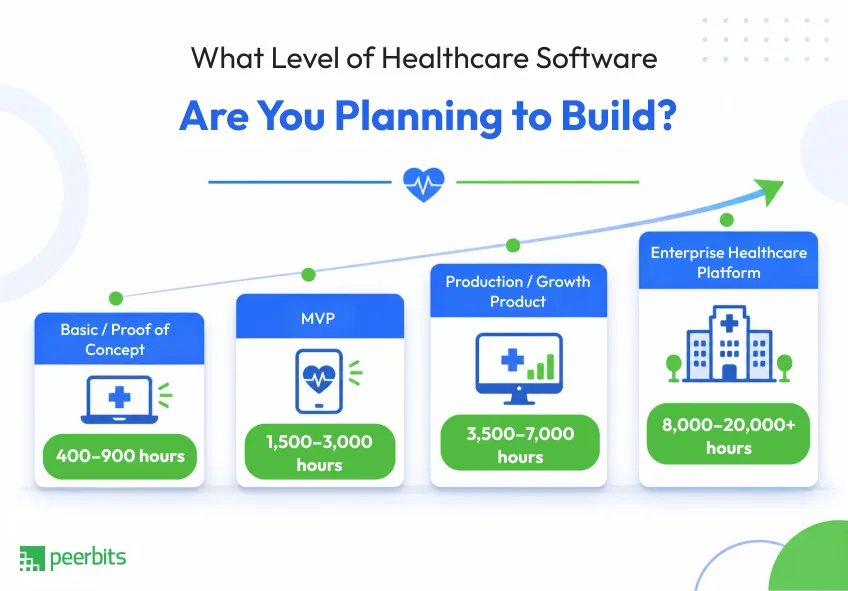
For this guide, Peerbits uses the following planning-hour ranges.
These are not published industry averages. They are practical estimation ranges from the detailed analysis of our expert team intended to help you compare project scope consistently.
| Development level | Indicative total team hours | Typical capabilities | What it gives you |
|---|---|---|---|
| Basic / Proof of Concept | 400–900 hours | One core workflow, limited users, basic interface, sandbox or mock data, basic backend, simple deployment | A way to validate technical feasibility, demonstrate the concept, or secure stakeholder approval |
| MVP | 1,500–3,000 hours | Secure authentication, core workflows, role-based access, basic admin, 1–2 integrations, notifications, auditability, cloud deployment, QA | A focused product that can support controlled real-world use, pilots, early customers, or market validation |
| Production / Growth Product | 3,500–7,000 hours | Multiple user roles, web/mobile experiences, 2–4 integrations, reporting, automation, monitoring, CI/CD, stronger scalability and security | A product ready for broader commercial or organizational adoption |
| Enterprise Healthcare Platform | 8,000–20,000+ hours | Multi-organization architecture, multiple EHR/API integrations, advanced IAM, high availability, disaster recovery, data migration, analytics/AI, enterprise administration | A scalable platform capable of supporting complex organizations, large user populations, or multiple products and locations |
Basic / Proof of Concept: 400–900 Hours
A basic build makes sense when you first need to prove that the concept or technology works.
You may focus on one clinical, patient, or operational workflow rather than developing the complete product. Where possible, a proof of concept should use synthetic, mock, or de-identified data rather than being treated as a production healthcare system.
Typical scope can include:
- one major workflow
- limited user roles
- basic interface
- simple backend
- sandbox API connection
- basic cloud deployment
- internal demonstration environment
Best suited for: technical validation, investor demonstrations, internal stakeholder approval, or early discovery.
MVP: 1,500–3,000 Hours
A healthcare MVP moves beyond demonstrating an idea.
You typically need enough product, architecture, security, and QA to put the application in front of controlled real users.
A typical healthcare software MVP may include:
- patient/provider or business user accounts
- secure authentication
- role-based access
- core product workflow
- basic administrative console
- notifications
- basic reporting
- one or two integrations
- audit logging
- cloud deployment
- functional and security testing
What it gives you: a focused first release you can pilot, validate commercially, or deploy to a controlled user group without funding your entire roadmap upfront.
Production / Growth Product: 3,500–7,000 Hours
Once your idea has been validated, the investment usually moves from proving functionality to healthcare product engineering that supports reliability, scale, integrations, automation, and continuous product use.
Capabilities commonly expand to:
- Multiple user roles
- Patient and provider applications
- Richer dashboards
- More healthcare integrations
- Workflow automation
- Reporting and analytics
- Data migration
- Performance optimization
- Monitoring and observability
- CI/CD
- Scalable cloud architecture
What it gives you: a product you can roll out more broadly across customers, providers, locations, or healthcare organizations.
Enterprise Healthcare Platform: 8,000–20,000+ Hours
Enterprise healthcare development is different again.
At this level, you may be supporting multiple healthcare organizations, complex interoperability, high data volumes, availability requirements, enterprise
administration, analytics, and several connected applications.
Typical capabilities can include:
- Multi-tenant or multi-organization architecture
- Multiple EHR/EMR integrations
- FHIR and HL7 interoperability
- Advanced identity and access management
- Complex auditability
- Large-scale data migration
- High availability
- Disaster recovery
- Advanced analytics
- AI capabilities
- Multiple portals or applications
- Enterprise reporting
- Performance and security testing
What it gives you: a healthcare technology ecosystem rather than only a standalone application.
Important Cost Principle
Do not compare two quotes until you know whether they are estimating the same development level.
For example, a $120,000 MVP proposal and a $400,000 enterprise-ready proposal may not represent a pricing difference at all. They may simply represent two completely different scopes.

Hashir Dhattiwala
Technical Lead, Peerbits
Define the Product Stage Before Estimating Development Cost
"A PoC, MVP, production-ready product, and enterprise platform may address the same business need, but each requires a different level of architecture, integrations, security, testing, and scalability. Cost estimates become much more reliable when the expected product maturity is defined first. Otherwise, you may end up comparing budgets for completely different levels of development."
Healthcare Software Development Cost by Country in 2027
Once you know the development level, geography becomes much easier to evaluate.
For this comparison, we use:
Estimated cost = total team hours × indicative planning rate
The hourly ranges below are Peerbits 2027 planning bands, not third-party directory averages or vendor quotations. They are calibrated against current labour-market evidence, software-engineering wage data, regional cost structures, and typical delivery economics.
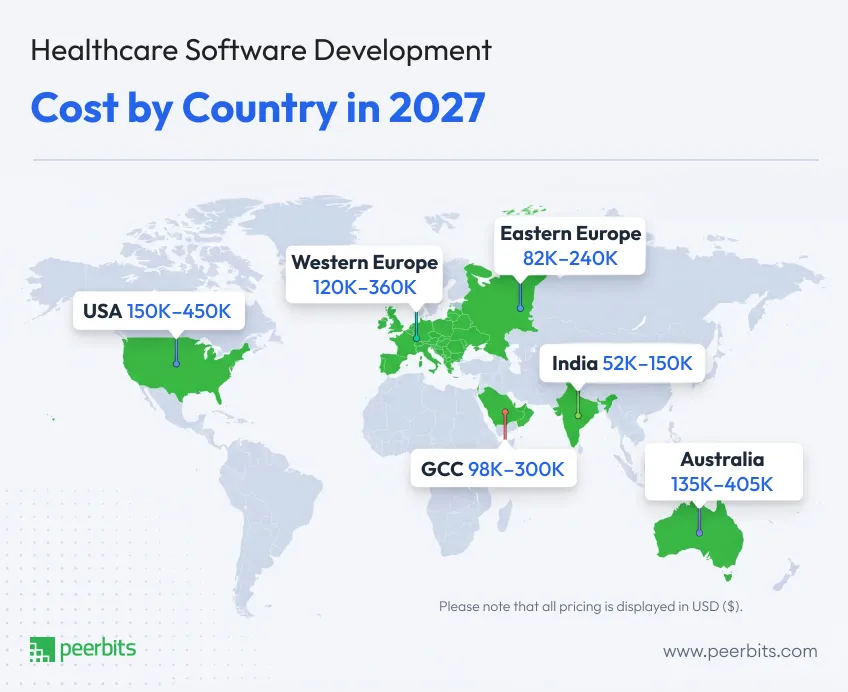
Let’s now explore healthcare software development cost by country:
Healthcare Software Development Cost in the USA
The USA is generally one of the most expensive locations for maintaining a software development team.
The U.S. Bureau of Labor Statistics reports a median annual software-developer wage of $135,980 in May 2025, with the highest 10% earning more than $214,670. Those figures represent employee wages rather than the complete cost of running an internal product-development organization.
| Development model | Hourly Rate (Approx.) | MVP: 1,500–3,000 hrs | Enterprise: 8,000–20,000 hrs |
|---|---|---|---|
| Healthcare / HealthTech Expert Company | $100–$150/hr | $150K–$450K | $800K–$3M |
| Generic Software Company | $80–$120/hr | $120K–$360K | $640K–$2.4M |
| In-house Development Team | $130–$190/hr | $195K–$570K | $1.04M–$3.8M |
| Freelancer / Independent Developer | $70–$110/hr | $105K–$330K | $560K–$2.2M |
When can the USA make sense?
This healthcare software development cost breakdown makes sense when local procurement, close stakeholder access, extensive on-site collaboration, or deep U.S.-market proximity outweighs the higher engineering economics.
Healthcare Software Development Cost in Western Europe
Western Europe can provide strong technical talent, regional proximity, and convenient collaboration for European healthcare businesses, but employment costs are comparatively high.
Eurostat estimates average hourly labour costs of €38.2 in the euro area in 2025, with non-wage costs accounting for 25.6% of total labour cost. These are economy-wide figures rather than software-developer rates, but they demonstrate why an employee's wage alone understates internal staffing cost.
| Development model | Hourly Rate (Approx.) | MVP: 1,500–3,000 hrs | Enterprise: 8,000–20,000 hrs |
|---|---|---|---|
| Healthcare / HealthTech Expert Company | $80–$120/hr | $120K–$360K | $640K–$2.4M |
| Generic Software Company | $65–$100/hr | $98K–$300K | $520K–$2M |
| In-house Development Team | $105–$150/hr | $158K–$450K | $840K–$3M |
| Freelancer / Independent Developer | $55–$85/hr | $82K–$255K | $440K–$1.7M |
The UK government's National Careers Service also places software-developer salaries at roughly £30,000 for starters to £75,000 for experienced developers, before the full employer cost of maintaining the team.
Healthcare Software Development Cost in Eastern Europe
Eastern Europe can offer a useful middle ground between Western European proximity and lower engineering economics.
Eurostat's 2025 labour-cost data illustrates how large the gap within Europe can be: overall hourly labour costs ranged from €12.0 in Bulgaria to €56.8 in Luxembourg.
| Development model | Hourly Rate (Approx.) | MVP: 1,500–3,000 hrs | Enterprise: 8,000–20,000 hrs |
|---|---|---|---|
| Healthcare / HealthTech Expert Company | $55–$80/hr | $82K–$240K | $440K–$1.6M |
| Generic Software Company | $40–$60/hr | $60K–$180K | $320K–$1.2M |
| In-house Development Team | $75–$105/hr | $112K–$315K | $600K–$2.1M |
| Freelancer / Independent Developer | $30–$50/hr | $45K–$150K | $240K–$1M |
When can Eastern Europe make sense? When European time-zone overlap matters but you want lower development economics than many Western European markets.
Healthcare Software Development Cost in India
India can be particularly attractive when you need significant engineering capacity over a long product roadmap.
The ranges below are not intended to say that every Indian company costs the same. Healthcare specialization, team seniority, architecture ownership, AI skills, interoperability experience, and project responsibility can all move the rate.
| Development model | Hourly Rate (Approx.) | MVP: 1,500–3,000 hrs | Enterprise: 8,000–20,000 hrs |
|---|---|---|---|
| Healthcare / HealthTech Specialist | $35–$50/hr | $52K–$150K | $280K–$1M |
| Generic Software Company | $25–$40/hr | $38K–$120K | $200K–$800K |
| In-house Development Team | $50–$70/hr | $75K–$210K | $400K–$1.4M |
| Freelancer / Independent Developer | $20–$35/hr | $30K–$105K | $160K–$700K |
When can India make sense?
India can be a strong choice when you want to optimize medical software development cost without compromising access to engineering capacity. It is especially suitable for MVP development, dedicated product teams, long-term roadmaps, and healthcare platforms that require skills across interoperability, cloud, data, AI, QA, DevOps, and integrations.
The key advantage is not simply a lower healthcare software developer hourly rate. It is the ability to allocate more of your budget to actual product development, specialist capabilities, and continuous scaling as your healthcare app evolves.
Healthcare Software Development Cost in Australia
Jobs and Skills Australia reports median hourly earnings of AUD 67 for software and applications programmers, based on May 2025 employee earnings data.
| Development model | Hourly Rate (Approx.) | MVP: 1,500–3,000 hrs | Enterprise: 8,000–20,000 hrs |
|---|---|---|---|
| Healthcare / HealthTech Specialist | $90–$135/hr | $135K–$405K | $720K–$2.7M |
| Generic Software Company | $75–$110/hr | $112K–$330K | $600K–$2.2M |
| In-house Development Team | $120–$165/hr | $180K–$495K | $960K–$3.3M |
| Freelancer / Independent Developer | $60–$95/hr | $90K–$285K | $480K–$1.9MFVF |
When can Australia make financial sense?
Australia can make sense when local collaboration, same-time-zone communication, and familiarity with the Australian healthcare market are more important than minimizing development cost.
It is particularly relevant for projects that require frequent stakeholder interaction, local procurement alignment, or close coordination with healthcare teams. For larger development programs, a hybrid model can preserve local oversight while reducing the cost of engineering delivery.
Healthcare App Development Cost in the GCC
GCC development economics can vary substantially depending on whether the full engineering organization is locally employed or a regional company uses a hybrid/offshore model.
| Development model | Hourly Rate (Approx.) | MVP: 1,500–3,000 hrs | Enterprise: 8,000–20,000 hrs |
|---|---|---|---|
| Healthcare / HealthTech Expert Company | $65–$100/hr | $98K–$300K | $520K–$2M |
| Generic Software Company | $50–$80/hr | $75K–$240K | $400K–$1.6M |
| In-house Development Team | $90–$130/hr | $135K–$390K | $720K–$2.6M |
| Freelancer / Independent Developer | $40–$70/hr | $60K–$210K | $320K–$1.4M |
A locally led hybrid model can be particularly relevant if you need GCC stakeholder access while placing a larger engineering team in a lower-cost development market.
When can the GCC make financial sense?
The GCC can make sense when your healthcare software project requires regional market understanding, Arabic-language support, close stakeholder access, or on-site coordination.
For larger or long-term healthcare platforms, a hybrid delivery model can be more cost-effective, keeping product leadership and market-facing responsibilities in the GCC while placing a larger share of engineering in a lower-cost development location.
What Does Location Mean for Your Healthcare Software Budget?
You should not choose a development location on hourly rate alone. A $30/hour team does not automatically produce a lower final medical software development cost than a $60/hour team. If the lower-cost team needs more development hours, lacks healthcare integration experience, requires significant rework, or cannot handle your security and interoperability requirements, the apparent savings can disappear.
For a more useful comparison, look at hourly rate × expected development hours × healthcare-specific capability. If two qualified teams can deliver approximately the same scope in the same number of hours, geography can create a significant cost difference. But if one team already understands EHR integrations, FHIR or HL7, healthcare data, security, and your target market, paying higher healthcare software development rates per hour can still result in a more feasible total project cost.
What Development Approach Makes Sense for You?
The most cost-effective development approach depends on how much healthcare expertise you already have internally, how complex the product is, and how much responsibility you want to manage yourself.
| Your situation | Development approach that may make sense |
|---|---|
| You already have a strong healthcare technology team | In-house development can give you greater control over product decisions and long-term knowledge retention. |
| You need to build a healthcare product but lack domain-specific technical expertise | A HealthTech-specialized software development company can reduce the learning curve around integrations, security, healthcare data, and interoperability. |
| You need standard application development with limited healthcare complexity | A generic software development company may be feasible if healthcare-specific requirements are relatively limited or managed internally. |
| You have a small, clearly defined technical task | A specialist freelancer can be cost-effective for isolated development, design, integration, or technical work. |
| You need continuous development without building a full internal team | A dedicated development team can provide ongoing capacity while keeping hiring and operational overhead lower. |
| You want local stakeholder access but lower development costs | A hybrid delivery model can combine local product or project leadership with offshore development. |
There is no single development model that is cheapest in every situation. A lower hourly rate can reduce your initial budget, but healthcare-specific rework, integration issues, security gaps, or additional management effort can increase the total cost.
The better comparison is therefore not simply “Which option charges less per hour?” but “Which option can deliver the required healthcare product with the least unnecessary cost, risk, and rework?”
What Does Different Healthcare Software Typically Cost?
Healthcare app development cost varies mainly by what you are building, how complex it is, and how far you want to take the product. A focused patient portal or mental health MVP requires a very different development effort from an enterprise EHR, RPM platform, or multi-system healthcare ecosystem.
The estimates below compare typical MVP and enterprise-level development hours across major healthcare software types, then apply the regional planning rates established earlier in this guide. They are intended to help you understand the likely investment range for different product categories, not act as fixed quotations.
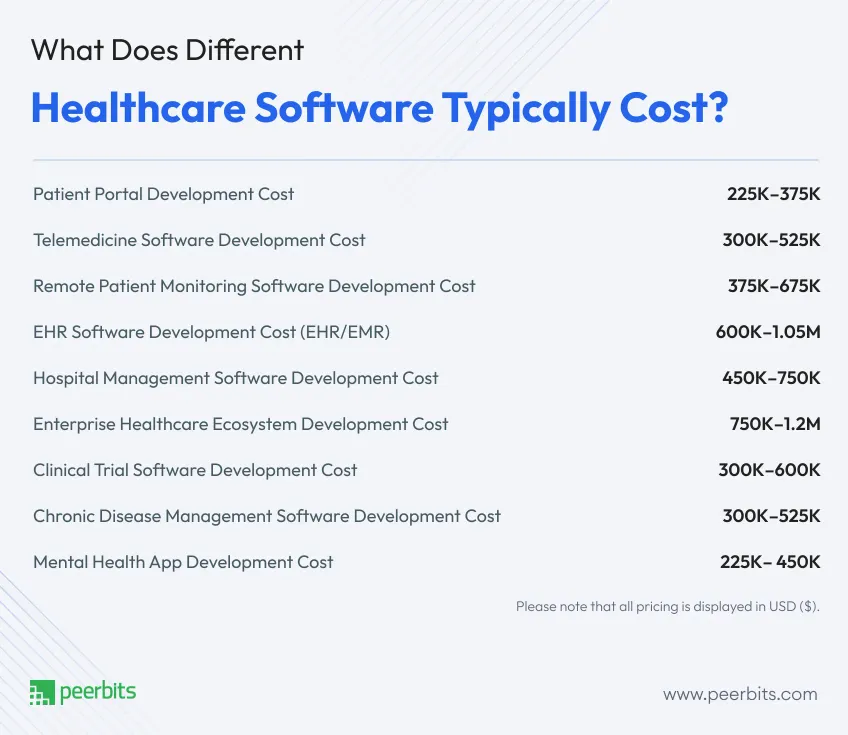
Current industry benchmarks reinforce how widely costs differ by software type. Let’s look at key software types and how cost differs for them:
Patient Portal Development Cost
Based on our detailed expert studies, a patient portal MVP can require approximately 1,500–2,500 total team hours when the first release focuses on patient access, appointments, records, communication, notifications, basic administration, and limited healthcare-system connectivity.
An enterprise patient portal software supporting multiple organizations, deeper EHR integrations, billing, lab or imaging data, telehealth, advanced permissions, and analytics may require approximately 5,000–10,000 hours.
HealthTech Software Development Expert Company
| Region | Hourly Rate (Approx.) | MVP: 1,500–2,500 hrs | Enterprise: 5,000–10,000 hrs |
|---|---|---|---|
| USA | ~$150/hr | $225K–$375K | $750K–$1.5M |
| Western Europe | ~$120/hr | $180K–$300K | $600K–$1.2M |
| Eastern Europe | ~$80/hr | $120K–$200K | $400K–$800K |
| India | ~$50/hr | $75K–$125K | $250K–$500K |
| Australia | ~$135/hr | $203K–$338K | $675K–$1.35M |
| GCC | ~$100/hr | $150K–$250K | $500K–$1M |
A healthcare-specialized company can make more sense when the portal requires EHR connectivity, patient-data exchange, interoperability, complex access controls, or broader product ownership.
Generic Software Development Company
| Region | Hourly Rate (Approx.) | MVP | Enterprise |
|---|---|---|---|
| USA | ~$120/hr | $180K–$300K | $600K–$1.2M |
| Western Europe | ~$100/hr | $150K–$250K | $500K–$1M |
| Eastern Europe | ~$60/hr | $90K–$150K | $300K–$600K |
| India | ~$40/hr | $60K–$100K | $200K–$400K |
| Australia | ~$110/hr | $165K–$275K | $550K–$1.1M |
| GCC | ~$80/hr | $120K–$200K | $400K–$800K |
This model can be feasible when your internal team already manages healthcare architecture, security, workflows, and integration requirements.
In-House Development Team
| Region | Hourly Rate (Approx.) | MVP | Enterprise |
|---|---|---|---|
| USA | ~$190/hr | $285K–$475K | $950K–$1.9M |
| Western Europe | ~$150/hr | $225K–$375K | $750K–$1.5M |
| Eastern Europe | ~$105/hr | $158K–$263K | $525K–$1.05M |
| India | ~$70/hr | $105K–$175K | $350K–$700K |
| Australia | ~$165/hr | $248K–$413K | $825K–$1.65M |
| GCC | ~$130/hr | $195K–$325K | $650K–$1.3M |
The in-house figure reflects the broader cost of maintaining the team, including compensation, benefits, recruitment, HR, infrastructure, management, tooling, training, and unused capacity.
Freelancers / Independent Developers
| Region | Hourly Rate (Approx.) | MVP | Enterprise |
|---|---|---|---|
| USA | ~$110/hr | $165K–$275K | $550K–$1.1M |
| Western Europe | ~$85/hr | $128K–$213K | $425K–$850K |
| Eastern Europe | ~$50/hr | $75K–$125K | $250K–$500K |
| India | ~$35/hr | $53K–$88K | $175K–$350K |
| Australia | ~$95/hr | $143K–$238K | $475K–$950K |
| GCC | ~$70/hr | $105K–$175K | $350K–$700K |
Cost perspective: If your immediate goal is patient self-service and controlled EHR access, an MVP may be enough. If the portal must become the patient-facing layer across several systems or facilities, budget closer to enterprise effort.
Telemedicine Software Development Cost
A telemedicine MVP may require around 2,000–3,500 hours for patient/provider accounts, scheduling, video consultation, secure messaging, notifications, and basic administration.
An enterprise telemedicine platform with e-prescribing, payments, multiple specialties, RPM, EHR integrations, advanced scheduling, analytics, and automation can require around 6,000–12,000 hours.
HealthTech Software Development Expert Company
| Region | Hourly Rate (Approx.) | MVP: 2,000–3,500 hrs | Enterprise: 6,000–12,000 hrs |
|---|---|---|---|
| USA | ~$150/hr | $300K–$525K | $900K–$1.8M |
| Western Europe | ~$120/hr | $240K–$420K | $720K–$1.44M |
| Eastern Europe | ~$80/hr | $160K–$280K | $480K–$960K |
| India | ~$50/hr | $100K–$175K | $300K–$600K |
| Australia | ~$135/hr | $270K–$473K | $810K–$1.62M |
| GCC | ~$100/hr | $200K–$350K | $600K–$1.2M |
Generic Software Development Company
| Region | Hourly Rate (Approx.) | MVP | Enterprise |
|---|---|---|---|
| USA | ~$120/hr | $240K–$420K | $720K–$1.44M |
| Western Europe | ~$100/hr | $200K–$350K | $600K–$1.2M |
| Eastern Europe | ~$60/hr | $120K–$210K | $360K–$720K |
| India | ~$40/hr | $80K–$140K | $240K–$480K |
| Australia | ~$110/hr | $220K–$385K | $660K–$1.32M |
| GCC | ~$80/hr | $160K–$280K | $480K–$960K |
In-House Development Team
| Region | Hourly Rate (Approx.) | MVP | Enterprise |
|---|---|---|---|
| USA | ~$190/hr | $380K–$665K | $1.14M–$2.28M |
| Western Europe | ~$150/hr | $300K–$525K | $900K–$1.8M |
| Eastern Europe | ~$105/hr | $210K–$368K | $630K–$1.26M |
| India | ~$70/hr | $140K–$245K | $420K–$840K |
| Australia | ~$165/hr | $330K–$578K | $990K–$1.98M |
| GCC | ~$130/hr | $260K–$455K | $780K–$1.56M |
Freelancers / Independent Developers
| Region | Hourly Rate (Approx.) | MVP | Enterprise |
|---|---|---|---|
| USA | ~$110/hr | $220K–$385K | $660K–$1.32M |
| Western Europe | ~$85/hr | $170K–$298K | $510K–$1.02M |
| Eastern Europe | ~$50/hr | $100K–$175K | $300K–$600K |
| India | ~$35/hr | $70K–$123K | $210K–$420K |
| Australia | ~$95/hr | $190K–$333K | $570K–$1.14M |
| GCC | ~$70/hr | $140K–$245K | $420K–$840K |
Cost perspective: If virtual consultation is your primary goal, a focused MVP can be far more feasible than immediately funding a complete virtual-care ecosystem.
Remote Patient Monitoring Software Development Cost
An RPM MVP can require 2,500–4,500 hours when it supports a focused condition, limited device types, patient applications, clinician dashboards, measurements, alerts, and basic integrations.
An enterprise multi-condition RPM platform can require approximately 8,000–16,000 hours.
HealthTech Software Development Expert Company
| Region | Hourly Rate (Approx.) | MVP: 2,500–4,500 hrs | Enterprise: 8,000–16,000 hrs |
|---|---|---|---|
| USA | ~$150/hr | $375K–$675K | $1.2M–$2.4M |
| Western Europe | ~$120/hr | $300K–$540K | $960K–$1.92M |
| Eastern Europe | ~$80/hr | $200K–$360K | $640K–$1.28M |
| India | ~$50/hr | $125K–$225K | $400K–$800K |
| Australia | ~$135/hr | $338K–$608K | $1.08M–$2.16M |
| GCC | ~$100/hr | $250K–$450K | $800K–$1.6M |
Generic Software Development Company
| Region | Hourly Rate (Approx.) | MVP | Enterprise |
|---|---|---|---|
| USA | ~$120/hr | $300K–$540K | $960K–$1.92M |
| Western Europe | ~$100/hr | $250K–$450K | $800K–$1.6M |
| Eastern Europe | ~$60/hr | $150K–$270K | $480K–$960K |
| India | ~$40/hr | $100K–$180K | $320K–$640K |
| Australia | ~$110/hr | $275K–$495K | $880K–$1.76M |
| GCC | ~$80/hr | $200K–$360K | $640K–$1.28M |
In-House Development Team
| Region | Hourly Rate (Approx.) | MVP | Enterprise |
|---|---|---|---|
| USA | ~$190/hr | $475K–$855K | $1.52M–$3.04M |
| Western Europe | ~$150/hr | $375K–$675K | $1.2M–$2.4M |
| Eastern Europe | ~$105/hr | $263K–$473K | $840K–$1.68M |
| India | ~$70/hr | $175K–$315K | $560K–$1.12M |
| Australia | ~$165/hr | $413K–$743K | $1.32M–$2.64M |
| GCC | ~$130/hr | $325K–$585K | $1.04M–$2.08M |
Freelancers / Independent Developers
| Region | Hourly Rate (Approx.) | MVP | Enterprise |
|---|---|---|---|
| USA | ~$110/hr | $275K–$495K | $880K–$1.76M |
| Western Europe | ~$85/hr | $213K–$383K | $680K–$1.36M |
| Eastern Europe | ~$50/hr | $125K–$225K | $400K–$800K |
| India | ~$35/hr | $88K–$158K | $280K–$560K |
| Australia | ~$95/hr | $238K–$428K | $760K–$1.52M |
| GCC | ~$70/hr | $175K–$315K | $560K–$1.12M |
Cost perspective: Device count, real-time data handling, alert logic, EHR connectivity, multi-condition programs, and analytics are among the biggest reasons RPM software moves toward enterprise-level effort.
EHR Software Development Cost (EHR/EMR)
A specialty-focused or limited EHR MVP may require approximately 4,000–7,000 hours.
A broad enterprise EHR system supporting clinical documentation, prescribing, billing, interoperability, reporting, patient access, specialty modules, and numerous external systems can require 12,000–30,000+ hours.
HealthTech Software Development Expert Company
| Region | Hourly Rate (Approx.) | MVP: 4,000–7,000 hrs | Enterprise: 12,000–30,000+ hrs |
|---|---|---|---|
| USA | ~$150/hr | $600K–$1.05M | $1.8M–$4.5M+ |
| Western Europe | ~$120/hr | $480K–$840K | $1.44M–$3.6M+ |
| Eastern Europe | ~$80/hr | $320K–$560K | $960K–$2.4M+ |
| India | ~$50/hr | $200K–$350K | $600K–$1.5M+ |
| Australia | ~$135/hr | $540K–$945K | $1.62M–$4.05M+ |
| GCC | ~$100/hr | $400K–$700K | $1.2M–$3M+ |
Generic Software Development Company
| Region | Hourly Rate (Approx.) | MVP | Enterprise |
|---|---|---|---|
| USA | ~$120/hr | $480K–$840K | $1.44M–$3.6M+ |
| Western Europe | ~$100/hr | $400K–$700K | $1.2M–$3M+ |
| Eastern Europe | ~$60/hr | $240K–$420K | $720K–$1.8M+ |
| India | ~$40/hr | $160K–$280K | $480K–$1.2M+ |
| Australia | ~$110/hr | $440K–$770K | $1.32M–$3.3M+ |
| GCC | ~$80/hr | $320K–$560K | $960K–$2.4M+ |
In-House Development Team
| Region | Hourly Rate (Approx.) | MVP | Enterprise |
|---|---|---|---|
| USA | ~$190/hr | $760K–$1.33M | $2.28M–$5.7M+ |
| Western Europe | ~$150/hr | $600K–$1.05M | $1.8M–$4.5M+ |
| Eastern Europe | ~$105/hr | $420K–$735K | $1.26M–$3.15M+ |
| India | ~$70/hr | $280K–$490K | $840K–$2.1M+ |
| Australia | ~$165/hr | $660K–$1.16M | $1.98M–$4.95M+ |
| GCC | ~$130/hr | $520K–$910K | $1.56M–$3.9M+ |
Freelancers / Independent Developers
| Region | Hourly Rate (Approx.) | MVP | Enterprise |
|---|---|---|---|
| USA | ~$110/hr | $440K–$770K | $1.32M–$3.3M+ |
| Western Europe | ~$85/hr | $340K–$595K | $1.02M–$2.55M+ |
| Eastern Europe | ~$50/hr | $200K–$350K | $600K–$1.5M+ |
| India | ~$35/hr | $140K–$245K | $420K–$1.05M+ |
| Australia | ~$95/hr | $380K–$665K | $1.14M–$2.85M+ |
| GCC | ~$70/hr | $280K–$490K | $840K–$2.1M+ |
Cost perspective: If you do not need to replace the underlying EHR, building or modernizing a connected module can be far more financially feasible than developing a complete EHR ecosystem.
Hospital Management Software Development Cost
A hospital management MVP may require around 3,000–5,000 hours for patient administration, scheduling, billing, inventory, staff coordination, and reporting.
A broader enterprise system spanning multiple departments, facilities, integrations, patient applications, pharmacy, labs, and revenue-cycle functionality can require 10,000–20,000 hours.
HealthTech Software Development Expert Company
| Region | Hourly Rate (Approx.) | MVP: 3,000–5,000 hrs | Enterprise: 10,000–20,000 hrs |
|---|---|---|---|
| USA | ~$150/hr | $450K–$750K | $1.5M–$3M |
| Western Europe | ~$120/hr | $360K–$600K | $1.2M–$2.4M |
| Eastern Europe | ~$80/hr | $240K–$400K | $800K–$1.6M |
| India | ~$50/hr | $150K–$250K | $500K–$1M |
| Australia | ~$135/hr | $405K–$675K | $1.35M–$2.7M |
| GCC | ~$100/hr | $300K–$500K | $1M–$2M |
Generic Software Development Company
| Region | Hourly Rate (Approx.) | MVP | Enterprise |
|---|---|---|---|
| USA | ~$120/hr | $360K–$600K | $1.2M–$2.4M |
| Western Europe | ~$100/hr | $300K–$500K | $1M–$2M |
| Eastern Europe | ~$60/hr | $180K–$300K | $600K–$1.2M |
| India | ~$40/hr | $120K–$200K | $400K–$800K |
| Australia | ~$110/hr | $330K–$550K | $1.1M–$2.2M |
| GCC | ~$80/hr | $240K–$400K | $800K–$1.6M |
In-House Development Team
| Region | Hourly Rate (Approx.) | MVP | Enterprise |
|---|---|---|---|
| USA | ~$190/hr | $570K–$950K | $1.9M–$3.8M |
| Western Europe | ~$150/hr | $450K–$750K | $1.5M–$3M |
| Eastern Europe | ~$105/hr | $315K–$525K | $1.05M–$2.1M |
| India | ~$70/hr | $210K–$350K | $700K–$1.4M |
| Australia | ~$165/hr | $495K–$825K | $1.65M–$3.3M |
| GCC | ~$130/hr | $390K–$650K | $1.3M–$2.6M |
Freelancers / Independent Developers
| Region | Hourly Rate (Approx.) | MVP | Enterprise |
|---|---|---|---|
| USA | ~$110/hr | $330K–$550K | $1.1M–$2.2M |
| Western Europe | ~$85/hr | $255K–$425K | $850K–$1.7M |
| Eastern Europe | ~$50/hr | $150K–$250K | $500K–$1M |
| India | ~$35/hr | $105K–$175K | $350K–$700K |
| Australia | ~$95/hr | $285K–$475K | $950K–$1.9M |
| GCC | ~$70/hr | $210K–$350K | $700K–$1.4M |
Cost perspective: If only selected hospital operations need digitalization, developing high-priority modules first can be significantly more feasible than funding the complete hospital ecosystem immediately.
Enterprise Healthcare Ecosystem Development Cost
An enterprise healthcare ecosystem may combine clinical applications, patient-facing products, integration infrastructure, analytics, administrative systems, data platforms, and cloud services.
Even the first enterprise foundation can require around 5,000–8,000 hours, while a mature ecosystem can reach 16,000–40,000+ hours.
HealthTech Software Development Expert Company
| Region | Hourly Rate (Approx.) | Initial foundation: 5,000–8,000 hrs | Enterprise: 16,000–40,000+ hrs |
|---|---|---|---|
| USA | ~$150/hr | $750K–$1.2M | $2.4M–$6M+ |
| Western Europe | ~$120/hr | $600K–$960K | $1.92M–$4.8M+ |
| Eastern Europe | ~$80/hr | $400K–$640K | $1.28M–$3.2M+ |
| India | ~$50/hr | $250K–$400K | $800K–$2M+ |
| Australia | ~$135/hr | $675K–$1.08M | $2.16M–$5.4M+ |
| GCC | ~$100/hr | $500K–$800K | $1.6M–$4M+ |
Generic Software Development Company
| Region | Hourly Rate (Approx.) | Initial foundation | Enterprise |
|---|---|---|---|
| USA | ~$120/hr | $600K–$960K | $1.92M–$4.8M+ |
| Western Europe | ~$100/hr | $500K–$800K | $1.6M–$4M+ |
| Eastern Europe | ~$60/hr | $300K–$480K | $960K–$2.4M+ |
| India | ~$40/hr | $200K–$320K | $640K–$1.6M+ |
| Australia | ~$110/hr | $550K–$880K | $1.76M–$4.4M+ |
| GCC | ~$80/hr | $400K–$640K | $1.28M–$3.2M+ |
In-House Development Team
| Region | Hourly Rate (Approx.) | Initial foundation | Enterprise |
|---|---|---|---|
| USA | ~$190/hr | $950K–$1.52M | $3.04M–$7.6M+ |
| Western Europe | ~$150/hr | $750K–$1.2M | $2.4M–$6M+ |
| Eastern Europe | ~$105/hr | $525K–$840K | $1.68M–$4.2M+ |
| India | ~$70/hr | $350K–$560K | $1.12M–$2.8M+ |
| Australia | ~$165/hr | $825K–$1.32M | $2.64M–$6.6M+ |
| GCC | ~$130/hr | $650K–$1.04M | $2.08M–$5.2M+ |
Freelancers / Independent Developers
| Region | Hourly Rate (Approx.) | Initial foundation | Enterprise |
|---|---|---|---|
| USA | ~$110/hr | $550K–$880K | $1.76M–$4.4M+ |
| Western Europe | ~$85/hr | $425K–$680K | $1.36M–$3.4M+ |
| Eastern Europe | ~$50/hr | $250K–$400K | $800K–$2M+ |
| India | ~$35/hr | $175K–$280K | $560K–$1.4M+ |
| Australia | ~$95/hr | $475K–$760K | $1.52M–$3.8M+ |
| GCC | ~$70/hr | $350K–$560K | $1.12M–$2.8M+ |
Cost perspective: At this level, phased delivery is usually more financially manageable than treating the complete healthcare ecosystem as one release.
Clinical Trial Software Development Cost
A focused clinical trial software MVP may require around 2,000–4,000 hours.
An enterprise platform supporting multiple studies, sites, participants, eConsent, eCOA/ePRO, integrations, payments, safety monitoring, and advanced analytics may require 8,000–18,000 hours.
HealthTech Software Development Expert Company
| Region | Hourly Rate (Approx.) | MVP: 2,000–4,000 hrs | Enterprise: 8,000–18,000 hrs |
|---|---|---|---|
| USA | ~$150/hr | $300K–$600K | $1.2M–$2.7M |
| Western Europe | ~$120/hr | $240K–$480K | $960K–$2.16M |
| Eastern Europe | ~$80/hr | $160K–$320K | $640K–$1.44M |
| India | ~$50/hr | $100K–$200K | $400K–$900K |
| Australia | ~$135/hr | $270K–$540K | $1.08M–$2.43M |
| GCC | ~$100/hr | $200K–$400K | $800K–$1.8M |
Generic Software Development Company
| Region | Hourly Rate (Approx.) | MVP | Enterprise |
|---|---|---|---|
| USA | ~$120/hr | $240K–$480K | $960K–$2.16M |
| Western Europe | ~$100/hr | $200K–$400K | $800K–$1.8M |
| Eastern Europe | ~$60/hr | $120K–$240K | $480K–$1.08M |
| India | ~$40/hr | $80K–$160K | $320K–$720K |
| Australia | ~$110/hr | $220K–$440K | $880K–$1.98M |
| GCC | ~$80/hr | $160K–$320K | $640K–$1.44M |
In-House Development Team
| Region | Hourly Rate (Approx.) | MVP | Enterprise |
|---|---|---|---|
| USA | ~$190/hr | $380K–$760K | $1.52M–$3.42M |
| Western Europe | ~$150/hr | $300K–$600K | $1.2M–$2.7M |
| Eastern Europe | ~$105/hr | $210K–$420K | $840K–$1.89M |
| India | ~$70/hr | $140K–$280K | $560K–$1.26M |
| Australia | ~$165/hr | $330K–$660K | $1.32M–$2.97M |
| GCC | ~$130/hr | $260K–$520K | $1.04M–$2.34M |
Freelancers / Independent Developers
| Region | Hourly Rate (Approx.) | MVP | Enterprise |
|---|---|---|---|
| USA | ~$110/hr | $220K–$440K | $880K–$1.98M |
| Western Europe | ~$85/hr | $170K–$340K | $680K–$1.53M |
| Eastern Europe | ~$50/hr | $100K–$200K | $400K–$900K |
| India | ~$35/hr | $70K–$140K | $280K–$630K |
| Australia | ~$95/hr | $190K–$380K | $760K–$1.71M |
| GCC | ~$70/hr | $140K–$280K | $560K–$1.26M |
Cost perspective: A focused study-management product and a platform covering much of the clinical trial lifecycle should not be budgeted as the same type of project.
Chronic Disease Management Software Development Cost
A condition-focused chronic disease management MVP may require 2,000–3,500 hours for patient tracking, care plans, reminders, communication, clinician visibility, and basic health-data capture.
A multi-condition chronic disease management platform with EHR integration, RPM, analytics, automation, and advanced personalization may require 7,000–14,000 hours.
HealthTech Software Development Expert Company
| Region | Hourly Rate (Approx.) | MVP: 2,000–3,500 hrs | Enterprise: 7,000–14,000 hrs |
|---|---|---|---|
| USA | ~$150/hr | $300K–$525K | $1.05M–$2.1M |
| Western Europe | ~$120/hr | $240K–$420K | $840K–$1.68M |
| Eastern Europe | ~$80/hr | $160K–$280K | $560K–$1.12M |
| India | ~$50/hr | $100K–$175K | $350K–$700K |
| Australia | ~$135/hr | $270K–$472.5K | $945K–$1.89M |
| GCC | ~$100/hr | $200K–$350K | $700K–$1.4M |
Generic Software Development Company
| Region | Hourly Rate (Approx.) | MVP | Enterprise |
|---|---|---|---|
| USA | ~$120/hr | $240K–$420K | $840K–$1.68M |
| Western Europe | ~$100/hr | $200K–$350K | $700K–$1.4M |
| Eastern Europe | ~$60/hr | $120K–$210K | $420K–$840K |
| India | ~$40/hr | $80K–$140K | $280K–$560K |
| Australia | ~$110/hr | $220K–$385K | $770K–$1.54M |
| GCC | ~$80/hr | $160K–$280K | $560K–$1.12M |
In-House Development Team
| Region | Hourly Rate (Approx.) | MVP | Enterprise |
|---|---|---|---|
| USA | ~$190/hr | $380K–$665K | $1.33M–$2.66M |
| Western Europe | ~$150/hr | $300K–$525K | $1.05M–$2.1M |
| Eastern Europe | ~$105/hr | $210K–$368K | $735K–$1.47M |
| India | ~$70/hr | $140K–$245K | $490K–$980K |
| Australia | ~$165/hr | $330K–$578K | $1.16M–$2.31M |
| GCC | ~$130/hr | $260K–$455K | $910K–$1.82M |
Freelancers / Independent Developers
| Region | Hourly Rate (Approx.) | MVP | Enterprise |
|---|---|---|---|
| USA | ~$110/hr | $220K–$385K | $770K–$1.54M |
| Western Europe | ~$85/hr | $170K–$298K | $595K–$1.19M |
| Eastern Europe | ~$50/hr | $100K–$175K | $350K–$700K |
| India | ~$35/hr | $70K–$123K | $245K–$490K |
| Australia | ~$95/hr | $190K–$333K | $665K–$1.33M |
| GCC | ~$70/hr | $140K–$245K | $490K–$980K |
Cost perspective: If you are initially targeting one condition such as diabetes, hypertension, or COPD, a focused MVP can keep your first investment considerably lower than a multi-condition platform.
Mental Health App Development Cost
A focused mental health MVP can require around 1,500–3,000 hours for assessments, symptom or mood tracking, appointments, communication, educational content, or treatment workflows.
An advanced behavioral-health platform with telepsychiatry, EHR connectivity, digital therapeutics, crisis-support workflows, accessibility capabilities, and AI can require 6,000–12,000 hours.
So here is how mental healthcare app development cost will look:
HealthTech Software Development Expert Company
| Region | Hourly Rate (Approx.) | MVP: 1,500–3,000 hrs | Enterprise: 6,000–12,000 hrs |
|---|---|---|---|
| USA | ~$150/hr | $225K–$450K | $900K–$1.8M |
| Western Europe | ~$120/hr | $180K–$360K | $720K–$1.44M |
| Eastern Europe | ~$80/hr | $120K–$240K | $480K–$960K |
| India | ~$50/hr | $75K–$150K | $300K–$600K |
| Australia | ~$135/hr | $203K–$405K | $810K–$1.62M |
| GCC | ~$100/hr | $150K–$300K | $600K–$1.2M |
Generic Software Development Company
| Region | Hourly Rate (Approx.) | MVP | Enterprise |
|---|---|---|---|
| USA | ~$120/hr | $180K–$360K | $720K–$1.44M |
| Western Europe | ~$100/hr | $150K–$300K | $600K–$1.2M |
| Eastern Europe | ~$60/hr | $90K–$180K | $360K–$720K |
| India | ~$40/hr | $60K–$120K | $240K–$480K |
| Australia | ~$110/hr | $165K–$330K | $660K–$1.32M |
| GCC | ~$80/hr | $120K–$240K | $480K–$960K |
In-House Development Team
| Region | Hourly Rate (Approx.) | MVP | Enterprise |
|---|---|---|---|
| USA | ~$190/hr | $285K–$570K | $1.14M–$2.28M |
| Western Europe | ~$150/hr | $225K–$450K | $900K–$1.8M |
| Eastern Europe | ~$105/hr | $158K–$315K | $630K–$1.26M |
| India | ~$70/hr | $105K–$210K | $420K–$840K |
| Australia | ~$165/hr | $248K–$495K | $990K–$1.98M |
| GCC | ~$130/hr | $195K–$390K | $780K–$1.56M |
Freelancers / Independent Developers
| Region | Hourly Rate (Approx.) | MVP | Enterprise |
|---|---|---|---|
| USA | ~$110/hr | $165K–$330K | $660K–$1.32M |
| Western Europe | ~$85/hr | $128K–$255K | $510K–$1.02M |
| Eastern Europe | ~$50/hr | $75K–$150K | $300K–$600K |
| India | ~$35/hr | $53K–$105K | $210K–$420K |
| Australia | ~$95/hr | $143K–$285K | $570K–$1.14M |
| GCC | ~$70/hr | $105K–$210K | $420K–$840K |
Cost perspective: If your product is centered around one mental-health use case, an MVP can be much more financially manageable than launching a complete behavioral-health ecosystem from the first release.
How to read these estimates: The costs above are calculated from Peerbits' indicative development-hour assumptions and the representative regional planning rates used earlier in this guide. They are intended for budget comparison, not as fixed project quotations. Actual healthcare software development pricing depends on scope, integrations, architecture, security requirements, platforms, data migration, team composition, and expected scale.
This keeps the same format and decision logic of the attached version, but fixes the main problem in the current pages 11–29: instead of using one broad “production-ready” hour range and one cost column, every product now clearly distinguishes MVP versus enterprise investment.
What Will You Pay After the Healthcare Software Is Launched?
Your medical software development cost does not end at deployment. After launch, you still need to budget for cloud infrastructure, third-party services, security updates, integration maintenance, technical support, monitoring, and ongoing product improvements.
This is especially important for healthcare applications connected to EHRs, devices, APIs, and sensitive health data. A realistic budget should therefore consider both the initial build cost and the long-term cost of operating, maintaining, and scaling the software.
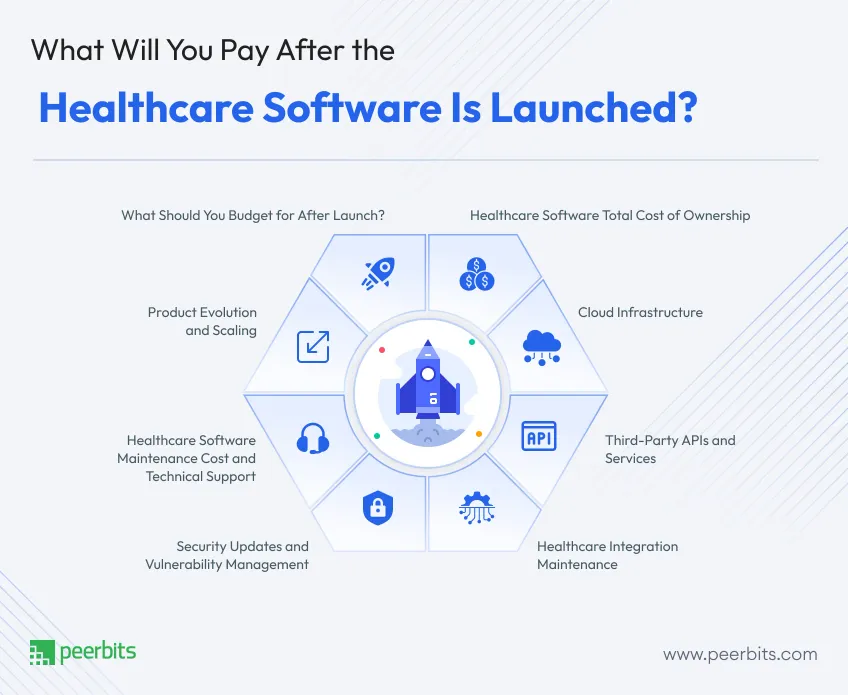
Healthcare Software Total Cost of Ownership
Your healthcare software total cost of ownership includes the initial build plus cloud infrastructure, third-party services, integrations, security, maintenance, support, and continued product evolution.
| Initial development investment | Ongoing ownership investment |
|---|---|
| Discovery and requirements | Cloud infrastructure |
| UX/UI design | Third-party services and APIs |
| Architecture | Monitoring and observability |
| Application development | Bug fixes and maintenance |
| EHR and third-party integrations | Security patches |
| QA and testing | Integration maintenance |
| Security implementation | Dependency and platform upgrades |
| Deployment | New functionality |
| Initial data migration | Performance optimization |
| Launch support | Scaling infrastructure |
Cloud Infrastructure
Your cloud bill can change as the number of users, transactions, stored health records, images, device data, analytics workloads, and AI workloads increases.
This is why cloud cost should not be treated as an afterthought.
Flexera's 2026 State of the Cloud Report found that 85% of surveyed organizations identified managing cloud spend as a top challenge, while respondents estimated that 29% of IaaS and PaaS cloud spend was being wasted. These figures are cross-industry rather than healthcare-specific, but they demonstrate why infrastructure architecture and ongoing cloud optimization can have a meaningful effect on software ownership costs.
For your healthcare application, cloud costs will depend on factors such as:
- user and patient volume
- data storage and retention
- medical images or large files
- real-time device data
- backup and disaster recovery
- geographic deployment
- high-availability requirements
- analytics and AI workloads
Third-Party APIs and Services
Your healthcare product may depend on external services for video consultations, SMS, email, maps, payments, e-prescribing, identity verification, analytics, EHR connectivity, or other functionality.
These services may charge by:
- API call
- active user
- message
- consultation minute
- transaction
- monthly subscription
- data volume
A low initial integration cost therefore does not necessarily mean a low long-term integration cost.
Before committing to an external service, calculate both its implementation cost and expected recurring usage cost.
Healthcare Integration Maintenance
An EHR, lab, pharmacy, payer, device, or other healthcare integration should not be considered a one-time expense.
External APIs change. Authentication requirements evolve. Data mappings may need adjustment. Vendors can deprecate endpoints or introduce newer versions.
If integrations are central to your product, reserve part of your ongoing development capacity for maintaining them.
Security Updates and Vulnerability Management
Security work continues after deployment.
HHS's healthcare-specific Cybersecurity Performance Goals identify mitigating known vulnerabilities as an essential cybersecurity goal for healthcare organizations and recommend practices including vulnerability management, endpoint protection, backups, incident planning, and other ongoing safeguards.
The financial consequence of neglecting security can also be substantial. IBM's 2025 Cost of a Data Breach Report found that healthcare remained the costliest industry for breaches, with an average studied breach cost of $7.42 million. That number is not a maintenance-cost estimate, but it demonstrates why security updates and monitoring should remain part of your post-launch budget.
Healthcare Software Maintenance Cost and Technical Support
Your maintenance budget can cover:
- production bug fixes
- framework and dependency upgrades
- browser and operating-system updates
- mobile OS compatibility
- database maintenance
- performance improvements
- monitoring
- backup verification
- technical support
There is no single maintenance percentage that applies to every healthcare product.
A small application with limited integrations can require relatively little ongoing engineering, while a multi-tenant healthcare platform connected to EHRs, devices, APIs, and multiple external systems may need continuous technical support.
For budget planning, ask your development partner to separate corrective maintenance, infrastructure, integration maintenance, security work, and new feature development rather than giving you one vague maintenance percentage.
Product Evolution and Scaling
You should also distinguish maintenance from product development.
Keeping an existing feature working is maintenance.
Adding a new clinical module, expanding into another market, introducing AI, supporting another EHR, creating a new mobile application, or adding another care model is continued product development.
These costs should be planned separately.
What Should You Budget for After Launch?
Instead of asking only:
“How much will it cost to build?”
ask:
“What will this healthcare product cost us to own and evolve over the next three to five years?”
For example, if your initial development investment is $200,000, model several ownership scenarios rather than assuming the launch price is your total investment.
| Illustrative annual ongoing budget | Annual amount | 3-year additional spend |
|---|---|---|
| 10% of initial build | $20,000 | $60,000 |
| 15% of initial build | $30,000 | $90,000 |
| 20% of initial build | $40,000 | $120,000 |
| 25% of initial build | $50,000 | $150,000 |
These percentages are illustrative scenarios, not universal healthcare maintenance benchmarks. Your actual ownership cost should be built from the infrastructure, maintenance, integrations, security, support, and product roadmap you expect to operate.
Decision takeaway: A development option that looks inexpensive at launch may not remain inexpensive once cloud, third-party services, integration maintenance, support, security, and continued product development are included.
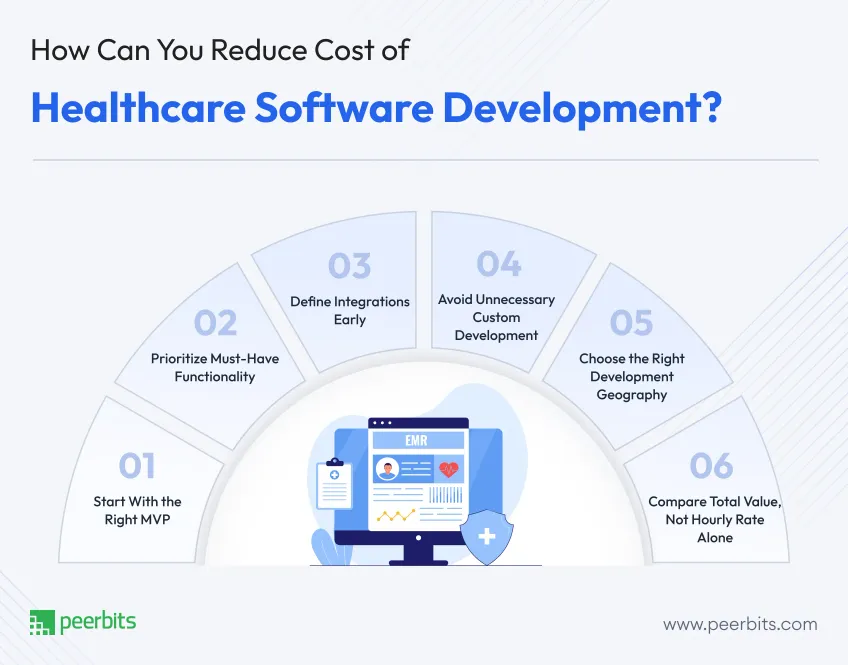
How Can You Reduce Cost of Healthcare Software Development?
Reducing cost of healthcare software development does not necessarily mean choosing the lowest hourly rate or removing important functionality.
The more sustainable approach is to reduce unnecessary development hours while protecting the healthcare capabilities your product actually needs.
1. Start With the Right MVP
Your MVP should test the core healthcare or business problem without trying to reproduce your complete long-term product roadmap.
Suppose your eventual platform is estimated at 5,000 development hours, but the functionality required to validate the product represents only 2,000 hours.
At a $40/hour development rate:
Full roadmap: 5,000 × $40 = $200,000
Initial MVP: 2,000 × $40 = $80,000
You have not necessarily eliminated the remaining $120,000 of development. You have deferred it until you have stronger evidence that those capabilities are worth building.
That distinction is important.
An MVP reduces your initial capital at risk, rather than magically making the complete product cheaper.
2. Prioritize Must-Have Functionality
Separate features into:
Must have: The application cannot deliver its intended healthcare or business outcome without them.
Should have: Valuable for adoption or operations but not essential for the first release.
Could have: Useful enhancements that can wait until product usage validates their value.
For example, a telemedicine MVP may need scheduling, patient/provider accounts, consultation functionality, notifications, and secure communication.
Advanced analytics, multiple care pathways, AI-assisted functionality, and extensive automation may be better suited to later phases.
Every feature you postpone removes design, development, QA, integration, and maintenance effort from your initial budget.
3. Define Integrations Early
Healthcare interoperability and integrations can materially change your application's architecture, data model, authentication, workflows, testing requirements, and development effort.
Before finalizing your estimate, identify:
- which EHR/EMR systems you need
- whether data exchange is read-only or bidirectional
- required FHIR or HL7 workflows
- medical devices or wearables
- laboratories
- pharmacies
- payers
- payment providers
- communication services
- existing internal systems
Discovering a major integration requirement halfway through development can turn what appeared to be a simple feature into an architectural change.
4. Avoid Unnecessary Custom Development
Not every component needs to be engineered from scratch.
Depending on your requirements, established services may be appropriate for capabilities such as:
- authentication
- video communication
- messaging
- payments
- cloud infrastructure
- notifications
- analytics
- document storage
Build custom functionality where it creates business, clinical, operational, or product differentiation.
Use established components where custom engineering creates little additional value.
However, evaluate recurring licensing costs, security, healthcare-data handling, vendor dependency, scalability, and integration limitations before making the build-versus-buy decision.
5. Choose the Right Development Geography
As the earlier cost tables demonstrate, the same number of development hours can produce substantially different project budgets depending on the location of your team.
For example, suppose your healthcare MVP requires 2,500 development hours. Using the healthcare-specialist planning rates discussed earlier, the same development effort could cost around $125,000 in India, $200,000 in Eastern Europe, $250,000 in the GCC, $300,000 in Western Europe, $337,500 in Australia, and $375,000 in the USA.
This does not mean the lowest-cost location is automatically the best choice. Consider the team's healthcare expertise, interoperability experience, communication model, stakeholder access, and delivery ownership alongside geography.
The goal is to choose a location that gives you the right healthcare capabilities at a development cost your product roadmap can sustain.
6. Compare Total Value, Not Hourly Rate Alone
Suppose Team A charges $30/hour and Team B charges $45/hour.
If Team A requires 5,000 hours because of additional learning, rework, or inefficient implementation:
5,000 × $30 = $150,000
If Team B can deliver the required scope in 3,000 hours:
3,000 × $45 = $135,000
The higher hourly rate produces the lower project cost.
This is why you should compare:
hourly rate × realistic hours × included expertise × expected rework × long-term ownership
rather than hourly rate alone.
Decision takeaway: The safest way to reduce healthcare software development cost is usually to reduce unnecessary scope, rework, and complexity, not simply to buy the cheapest engineering hours.
Which Development Option Is Most Feasible for You?
There is no development model that is financially optimal for every healthcare project.
Your most feasible option depends on what you already have internally, how long you expect development to continue, how healthcare-specific the product is, and how much technical responsibility you want to retain.
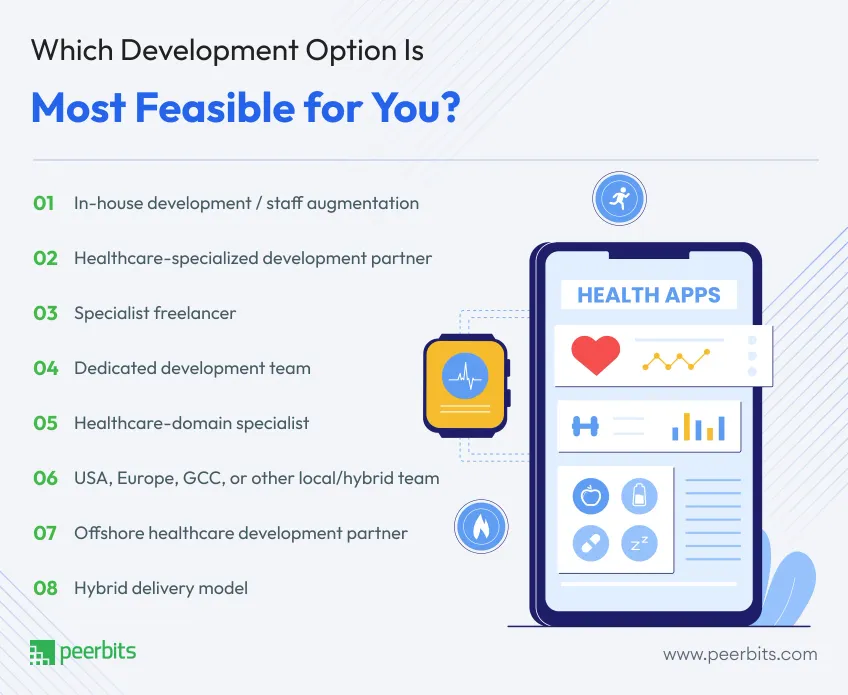
| If your situation is... | Consider... | Why it may be financially feasible |
|---|---|---|
| You already have a mature healthcare technology team | In-house development / staff augmentation | You retain product knowledge and control while adding capacity only where needed. |
| You lack healthcare software expertise | Healthcare-specialized development partner | Existing healthcare knowledge can reduce the domain-learning burden around data, integrations, security, and interoperability. |
| You need a small, isolated technical task | Specialist freelancer | You avoid funding a complete external team for a narrow requirement. |
| You need continuous external product development | Dedicated development team | You gain stable engineering capacity without recruiting an entire permanent internal team. |
| Your product depends heavily on EHRs, FHIR, HL7, devices, or healthcare systems | Healthcare-domain specialist | Relevant integration experience may reduce discovery, implementation, and rework effort. |
| Local presence is essential | USA, Europe, GCC, or other local/hybrid team | Higher rates may be justified by procurement needs, stakeholder access, market familiarity, or on-site collaboration. |
| Budget efficiency and specialist capability both matter | Offshore healthcare development partner | You can access healthcare-specific skills at lower development economics than many onshore markets. |
| You need local stakeholder access but want lower engineering costs | Hybrid delivery model | Product leadership or client-facing functions can remain local while engineering is distributed to a more cost-efficient region. |
Decision takeaway: Match the development model to the capability you already have. Paying an external company for expertise you already possess may be unnecessary, but choosing a low-cost implementation team when you lack healthcare technical leadership can create expensive gaps.
What Do You Need for an Accurate Healthcare Software Development Cost Estimate?
A development company cannot estimate your healthcare product accurately from a description such as:
“We need a telemedicine app.”
Two telemedicine applications can have completely different costs depending on the number of user roles, integrations, workflows, platforms, security requirements, and expected scale.
Before requesting proposals, prepare answers to the following questions.
1. What Are You Building?
Define the product as clearly as possible.
For example:
- Patient portal
- Telemedicine application
- RPM platform
- Chronic disease management application
- Clinical trial platform
- EHR-connected application
- Healthcare SaaS product
- Hospital management system
2. Who Will Use It?
Identify every major user group.
These may include:
- Patients
- Physicians
- Nurses
- Administrators
- Care coordinators
- Researchers
- Trial participants
- Payers
- Employers
- Caregivers
Every additional user role can create different screens, workflows, permissions, notifications, and testing requirements.
3. What Are the Must-Have Features?
Separate phase-one functionality from your longer roadmap.
Your estimation document should make clear:
What must exist at launch?
and
What can be added after the product proves its value?
This prevents vendors from estimating two completely different scopes.
4. Do You Need Web, Mobile, or Both?
Specify whether you need:
- Web application
- Mobile App Development
- iOS application
- Android application
- Cross-platform mobile application
- Patient-facing application
- Provider-facing application
- Administrative portal
Supporting more interfaces normally increases design, development, testing, and maintenance effort.
5. What Systems Must It Integrate With?
List every known external system.
For example:
- EHR/EMR
- FHIR APIs
- HL7 interfaces
- Laboratories
- Pharmacies
- Medical devices
- Wearables
- Payment systems
- CRM
- Billing platforms
- Identity providers
Also specify whether each integration needs to read data, write data, or both.
6. Is Existing Healthcare Data Being Migrated?
If you are replacing or modernizing an existing system, estimate:
- Data volume
- Number of sources
- Existing formats
- Data quality
- Historical records required
- Transformation and mapping requirements
Data migration can become a separate workstream rather than a small deployment task.
7. Which Country or Market Will the Software Operate In?
The market affects more than developer rates.
It can influence:
- Privacy requirements
- Healthcare regulations
- Hosting choices
- Accessibility expectations
- Language
- Integrations
- Clinical workflows
- Procurement requirements
For US projects involving ePHI and regulated entities, identifying the data scope early is particularly important. HHS states that organizations subject to the HIPAA Security Rule must assess risks and vulnerabilities to all ePHI they create, receive, maintain, or transmit.
8. What Scale Do You Expect?
Your estimate should state whether the system is expected to serve:
- Hundreds of users
- Thousands
- Hundreds of thousands
- Multiple healthcare organizations
- Multiple countries or regions
Architecture designed for a small pilot can be very different from infrastructure intended for an enterprise healthcare platform.
Healthcare Software Cost Estimation Checklist
Before requesting a quote, you should ideally be able to provide:
- Product type
- Target users
- Must-have features
- Web/mobile requirements
- Integrations
- Data migration requirements
- Target market
- Security and healthcare-data requirements
- Expected scale
- Existing technical resources
- Phase-one scope
- Longer product roadmap
Decision takeaway: The more clearly you define these variables, the easier it becomes to determine whether a $100,000, $250,000, or $500,000 proposal represents a real cost difference or simply a different interpretation of your requirements.
Tips to Select the Right Healthcare Software Development Partner
Choosing the right healthcare software development partner is not only about comparing hourly rates. You should evaluate whether the team can understand your healthcare environment, deliver the required technical scope, communicate effectively, and support the product as it grows.
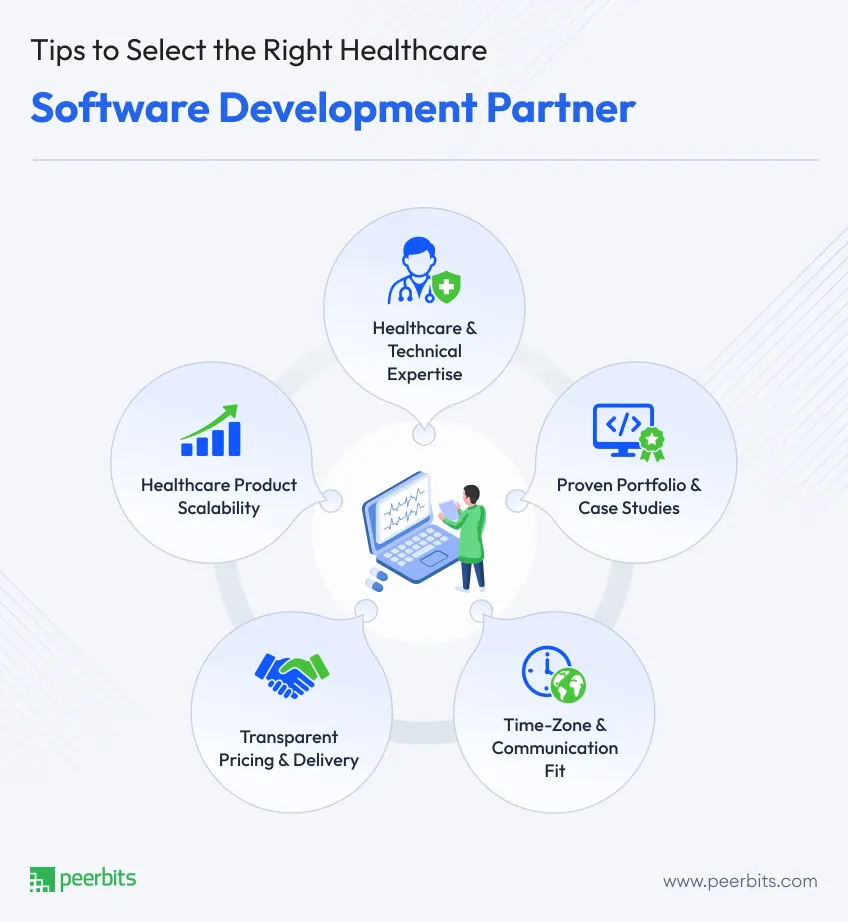
1. Strong Healthcare Domain Expertise and Technical Fit
Look for a partner that understands healthcare-specific requirements, not just general software development. The team should be comfortable discussing interoperability, healthcare data, security, EHR integrations, cloud architecture, and the workflows your users actually depend on.
The technical fit should also match your product. A company strong in standard web development may not be the right choice for an RPM platform, EHR-connected application, medical device software, or complex healthcare SaaS product.
2. Proven Portfolio With Relevant Case Studies
Do not rely only on claims such as “we have healthcare experience.” Review actual case studies and ask what the team was responsible for.
Look for evidence of work involving products similar to yours, including the problem solved, integrations handled, technical complexity, scalability requirements, and measurable outcome.
A relevant portfolio helps you judge whether the partner has already dealt with challenges similar to the ones that could affect your development cost and timeline.
3. Time-Zone Alignment and a Clear Communication Model
The team does not have to work in your country, but it should have a reliable communication model that supports your working hours.
Ask how the partner handles:
- overlapping working hours
- sprint reviews
- daily or weekly communication
- stakeholder meetings
- issue escalation
- documentation
- project ownership
For US, European, or GCC healthcare companies working with an offshore team, structured overlap and clear ownership can make distributed development much smoother without giving up the cost advantages of offshore delivery.
4. Transparent Cost, Scope, and Delivery Responsibility
A lower quote is not always the lower-cost option.
Before selecting a partner, check exactly what the estimate includes: discovery, design, architecture, development, integrations, QA, DevOps, security work, deployment, documentation, and post-launch support.
You should also understand what is excluded, how change requests are priced, and who is responsible if an integration or technical dependency takes more effort than expected.
The best proposal is the one that gives you a clear view of total required investment, not simply the lowest initial number.
5. Ability to Scale With Your Healthcare Product
Your first release may require a small team, but your needs can change quickly after launch.
Choose a partner that can add the right capabilities as your product evolves, such as:
- healthcare integration specialists
- cloud engineers
- QA automation
- data engineers
- AI specialists
- DevOps
- security expertise
- additional web or mobile developers
This matters because replacing a development partner mid-roadmap can introduce onboarding, knowledge-transfer, architecture, and continuity costs.
Decision takeaway: The right healthcare software development partner should help you control more than the initial development cost. It should reduce avoidable rework, support effective collaboration, and give you the technical depth to keep the product moving as your requirements grow.
Why India Is a Strong Choice for Healthcare Software Development
If you are a HealthTech company, healthcare SaaS provider, hospital, or digital health business in the USA, Europe, or GCC, India can give you something difficult to get from many higher-cost markets: a large engineering talent pool combined with substantially lower development economics.
The advantage is not simply that developers cost less. It is that you can potentially put more of the same budget into engineering capacity, integrations, QA, cloud, security, and continued product development.
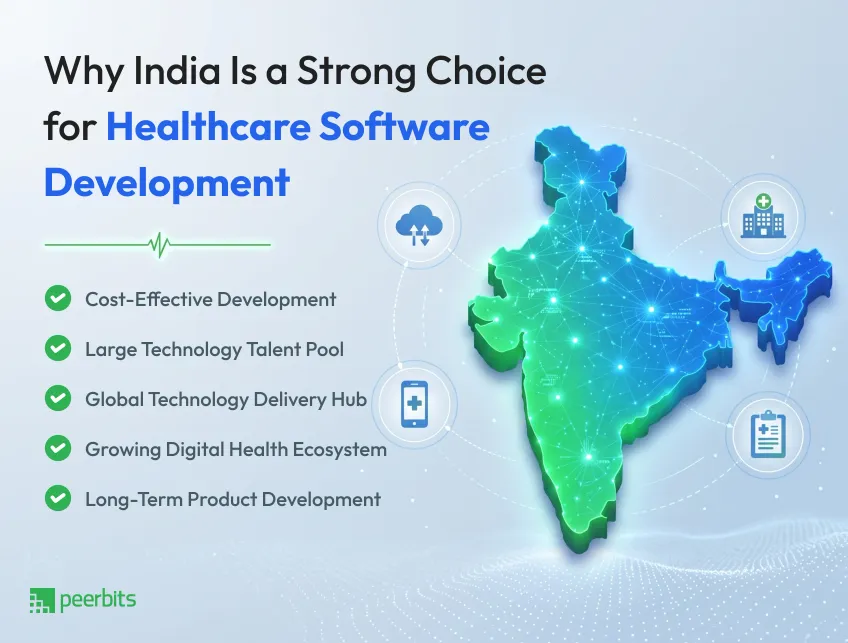
1. Your Development Budget Can Go Significantly Further
India's cost advantage is not based only on lower developer rates. The country continues to rank strongly as a global delivery destination because of the combination of financial attractiveness, talent availability, and established technology-delivery capacity.
Kearney's Global Services Location Index ranks India #1 globally among offshore service locations. In its 2023 assessment, India scored particularly strongly on financial attractiveness, a measure that considers factors such as compensation costs, infrastructure expenses, and tax and regulatory costs.
The financial impact becomes clearer when you apply the planning rates used in this guide. For example, if the same healthcare MVP requires 3,000 development hours, an India-based healthcare-specialized team at an indicative $50/hour represents approximately $150,000, compared with about $450,000 at an indicative $150/hour in the USA.
These figures are Peerbits' healthcare app development cost 2027 researched calculations, not market-average project prices. They illustrate how development geography can change the amount of engineering capacity you can fund when product scope and required effort remain the same.
For a HealthTech company, healthcare SaaS provider, or digital health business, that difference can allow more of the same budget to go toward integrations, QA, cloud engineering, security, data capabilities, and subsequent product releases rather than being absorbed primarily by higher development economics.
India also has the delivery scale to support that model. IBEF, citing NASSCOM, reports that India's IT and BPM industry reached approximately $315 billion in FY2026, including about $246.4 billion in exports.
2. Lower Rates Come With a Large Technology Talent Base
India's cost advantage would be much less useful if specialist engineering talent were difficult to find.
GitHub reported 21.9 million developers in India in 2025, making it the second-largest developer population on its platform. India added more than 5.2 million developers during 2025 alone, the largest increase of any country that year.
The wider technology industry is also substantial. NASSCOM expects India's technology sector to cross $315 billion in FY2026, with direct technology employment approaching 6 million professionals.
For you, that larger talent base matters when a healthcare product needs more than application developers. As the product grows, you may also need cloud, data, AI, DevOps, QA automation, cybersecurity, mobile, or integration expertise without moving the development operation to another country.
3. India Is a Major Global Technology Delivery Hub
India’s technology ecosystem is also backed by a large concentration of global enterprise development operations. According to the Nasscom–Zinnov GCC Landscape 2026 report, India hosts 2,117 Global Capability Centers across 3,728 operating units, employing about 2.36 million professionals. Most of these are certified developers. The report also states that 506 Forbes Global 2000 companies operate GCCs in India, highlighting the country’s role in global engineering, product, AI, cloud, and technology delivery.
That presence includes some of the world’s largest technology companies. For example, Microsoft India Development Center operates in Hyderabad, Bengaluru, and Noida, and Microsoft describes it as one of its largest R&D centers outside Redmond. Its India teams work on products and platforms across areas such as AI, cloud, enterprise software, and devices.
4. India Also Has a Growing Standards-Based Digital Health Environment
India is not operating outside modern digital-health interoperability.
The Government of India's Ayushman Bharat Digital Mission (ABDM) is building an open, interoperable digital health ecosystem with common data standards and secure health-information exchange. Government documentation describes privacy by design, consent-based health-data exchange, application validation, security audits, and interoperability across different healthcare systems.
ABDM initiatives also explicitly reference standards such as FHIR for health-data exchange.
This does not mean every Indian development company has healthcare interoperability expertise. You should still verify the individual partner's experience with FHIR, HL7, EHR integrations, healthcare security, and your target country's requirements.
What it does show is that India's technology ecosystem increasingly operates around the same interoperability and digital-health concepts that modern healthcare products require.
5. India Can Work Particularly Well for Long-Term Product Development
The cost difference becomes more meaningful when your requirement extends beyond one release.
If you need to maintain a dedicated product team for several years, continue adding EHR integrations, introduce new applications, scale cloud infrastructure, or expand into additional markets, the difference in hourly engineering economics compounds over time.
For buyers in the USA and Europe, India can also support a distributed model where your product and stakeholder teams retain local working hours while part of the engineering work continues across time zones. For GCC organizations, the smaller time difference can provide even greater same-day collaboration.
The model works best when communication windows, sprint ceremonies, technical ownership, documentation, and escalation processes are established from the beginning.

Shahid Mansuri
CEO, Peerbits
Cost Advantage Works Best When It Comes With Delivery Maturity
"India’s advantage in healthcare software development is not simply lower engineering cost. The stronger value comes from combining cost efficiency with access to experienced technology teams, broad technical capabilities, and the capacity to support a product over multiple stages of growth. For healthcare companies, that balance can make development budgets more sustainable without limiting long-term product ambitions."
Why Healthcare Companies Consider Peerbits for Cost-Effective Development in India
Cost-effective healthcare software development is not only about paying a lower hourly rate. The real advantage comes from reducing hiring overhead, avoiding unnecessary rework, accessing the right healthcare expertise from one team, and maintaining delivery continuity as the product grows.
Peerbits combines India-based engineering economics with 15+ years of software engineering experience, 180+ in-house technology experts, and healthcare-specific capabilities that can help you use your development budget more efficiently.
1. Lower Engineering Economics With In-House Delivery Capacity
With its engineering base in India and 180+ in-house technology experts, Peerbits can provide development capacity without requiring you to build and maintain an equivalent internal team.
This can reduce the broader cost of recruitment, HR, infrastructure, management, tooling, and long-term staffing while giving you access to the skills required across development, QA, cloud, data, AI, and integrations.
2. Healthcare Expertise That Helps Reduce Rework
Healthcare-specific mistakes can become expensive when architecture, integrations, security, or data requirements are identified too late.
With experience around HIPAA and HITECH requirements, healthcare data standards such as ICD-10, CPT, LOINC, and SNOMED CT, and healthcare workflows, Peerbits can address these requirements earlier in development and reduce avoidable rework.
3. Interoperability Expertise Without Multiple Specialist Vendors
Healthcare products often require specialist knowledge across FHIR, HL7, SMART on FHIR, and EHR/EMR integrations. And peerbits operate with certified developers to meet your requirements.
Having these capabilities within the same development partner can reduce the need to hire separate interoperability vendors, simplify coordination, and keep more of your budget within one delivery structure.

Ubaid Pisuwala
CTO, Peerbits
Plan Interoperability Early to Control Development Costs
"Interoperability becomes expensive when it is treated as a late-stage integration task. Planning FHIR resources, data flows, APIs, authentication, and EHR dependencies early helps avoid architecture changes and repeated development later. For healthcare companies, the cost advantage comes from getting the interoperability foundation right from the beginning, not simply from connecting systems at the end."
4. One Team Across Core and Advanced Technology Needs
As your product evolves, you may need capabilities beyond application development, including healthcare AI, cloud, interoperability, and modernization.
Accessing these skills through one technology partner can be more cost-efficient than repeatedly sourcing new teams for different stages of your roadmap.
5. Relevant Medical Software Capabilities That Reduce the Learning Curve
For healthcare and medical software requiring greater technical rigor, Peerbits brings capabilities relevant to FDA Class II and III software and IEC 62304 Classes A, B, and C.
This can reduce the cost and time associated with onboarding a general software team that still needs to understand medical-software engineering expectations.
6. Delivery Experience Across the US, GCC, EU, and Global Market
Peerbits' healthcare technology experience across US, GCC, and EU ecosystems can make India-based delivery more practical for companies building for international markets.
Better alignment with target-market expectations can reduce unnecessary clarification, rework, and coordination overhead while allowing you to retain the cost advantages of an India-based engineering team.
Cost perspective: The value of choosing Peerbits is not simply access to lower development rates in India. It is the ability to combine cost-efficient engineering, healthcare expertise, specialist capabilities, and scalable in-house capacity within one development partner.
Frequently Asked Questions
Healthcare software development can range from around $50,000 for a focused MVP to $500,000+ for complex, integration-heavy platforms, while enterprise healthcare systems can exceed $1 million. Your final cost depends on development hours, application complexity, integrations, security requirements, team location, and delivery model.
Healthcare software development hourly rates typically vary by region and team type. India can average around $38/hour, while rates in markets such as the USA, UK, Germany, Australia, and the UAE can be significantly higher. A healthcare-specialized team may also charge more than a general software company because of domain and integration expertise.
Healthcare app development cost in the USA is generally more expensive because of higher engineering and operating costs. Depending on the team and project complexity, rates can range from roughly $50 to $150+ per hour, which can push a multi-thousand-hour healthcare project well into six figures.
A custom healthcare app development cost can lead to approximately $50,000 to $300,000+, depending on whether you need a simple patient-facing application, telemedicine functionality, EHR integrations, remote monitoring, analytics, or advanced security features. More complex multi-user or enterprise healthcare apps can cost significantly more.
A healthcare software MVP can typically cost around $50,000 to $150,000+, depending on the number of features, platforms, integrations, and the location of your development team. A focused MVP reduces your initial investment by prioritizing only the functionality required to validate the product.
The biggest cost factors are product complexity, development hours, team location, development model, EHR or third-party integrations, security requirements, data migration, user roles, scalability, and ongoing maintenance. Integration-heavy or enterprise healthcare products generally require more engineering effort than standalone applications.
Healthcare EHR integration cost depends on the EHR vendor, number of systems, data exchanged, and whether the integration is read-only or bidirectional. A simple API connection may require relatively limited effort, while multiple FHIR, HL7, or custom EHR integrations can add tens of thousands of dollars or more to the project.
There is no fixed HIPAA-compliant software development cost because HIPAA does not add one standard fee. Your cost depends on the safeguards your application requires, including access controls, encryption, audit logging, secure data handling, risk management, monitoring, and documentation.
Ongoing healthcare software maintenance can include cloud hosting, security updates, bug fixes, monitoring, API maintenance, EHR integrations, platform upgrades, and new features. Instead of applying one fixed percentage, you should estimate each recurring cost based on your actual architecture, integrations, usage, and roadmap.
It depends on the capability you already have. In-house development can make sense if you have a mature healthcare technology team and a long-term product roadmap. Outsourcing can be more cost-effective when you need healthcare-specific expertise, faster team scaling, or lower development economics without carrying permanent hiring and operating costs.
India can offer a combination of lower hourly development rates, a large engineering talent pool, and access to skills across cloud, AI, mobile, data, QA, and healthcare integrations. It can be especially cost-effective for long-term development programs where the difference in hourly rates compounds over thousands of development hours.
You can reduce cost by starting with the right MVP, prioritizing must-have features, defining integrations early, avoiding unnecessary custom development, choosing the right development geography, and comparing total project value instead of hourly rate alone. The goal is to reduce unnecessary effort and rework, not simply choose the cheapest development team.